Exclusive Interview by Solomon OKPO
Akwa Ibom State is steadily repositioning itself as a major sports destination in Nigeria, with the state government combining modern sporting infrastructure, grassroots talent discovery, athlete welfare and increased hosting of major competitions in its drive to build a sustainable sports ecosystem.
At the centre of the renewed sports development strategy is Governor Umo Eno’s establishment of a standalone Ministry of Sports Development, a decision the Commissioner for Sports Development, Elder Paul ‘Sports’ Bassey, described as evidence of the Governor’s deliberate commitment to making sports a major instrument of youth development, empowerment and economic growth.
Speaking in an exclusive interview, Bassey said the Governor’s vision goes beyond winning competitions or hosting major football matches, stressing that the ultimate objective is to create a system capable of producing athletes who can build sustainable careers and livelihoods through sports.
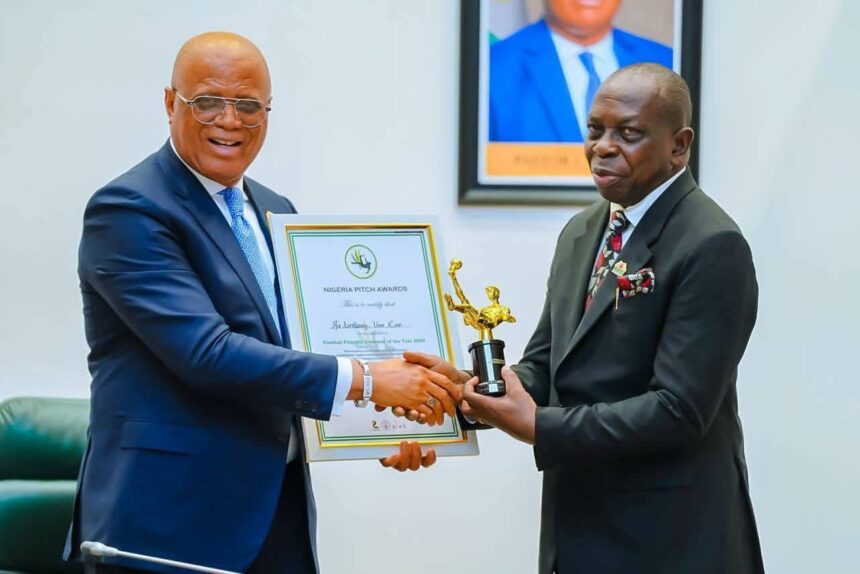
According to him, Akwa Ibom’s recent recognition at the Nigeria Pitch Awards, where Governor Umo Eno emerged as Football Friendly Governor of the Year with 123 points, reflects the administration’s commitment to sports development.
He identified the Godswill Akpabio International Stadium, Uyo, the Governor’s support for the Super Eagles and the administration’s emphasis on grassroots competitions as some of the factors behind the recognition.
“As long as we have the iconic Godswill Akpabio International Stadium in Uyo, which has become one of the very few stadiums in Nigeria capable of hosting major international fixtures, including the Super Eagles, and as long as we have a Governor who takes the welfare of the national team seriously whenever they come to Akwa Ibom, there is no contest,” Bassey said.
He, however, stressed that the administration’s sports policy extends beyond football.
According to him, Governor Eno has recognised football as the “king of sports” while simultaneously giving attention to other sporting disciplines, thereby creating a broader foundation for sports development across the state.
Standalone Ministry, Deliberate Strategy:
Bassey said the decision to separate sports from the former Ministry of Youth and Sports was one of Governor Eno’s campaign commitments which he fulfilled immediately after assuming office.
He explained that the creation of the Ministry of Sports Development provided the institutional platform for the government to concentrate resources, policies and programmes specifically on sports.
“That decision tells you that this is a Governor who knows exactly what he wants to achieve. He believes that sports, when given a dedicated ministry and focused attention, can achieve much more,” he said.
The Commissioner noted that sports remained a powerful instrument for youth development and empowerment, adding that the government’s approach was designed to strengthen the entire sports ecosystem rather than focus exclusively on elite competitions.
Grassroots Talent Discovery
At the 2026 Akwa Ibom State Sports Festival, which brought together athletes from the state’s 31 local government areas, Bassey said the competition was designed primarily as a grassroots talent-discovery mechanism.
He said athletes competing at the state level were products of competitions and talent identification at the local government level.
A major innovation, according to him, is the reward system introduced by the Governor, under which athletes who win gold medals at the festival receive ₦500,000.
Bassey said athletes who win medals in multiple events could earn considerably more, providing them with an immediate incentive to take sports seriously.
“That reward culture gives these young people hope. It makes them understand that they can have a future in sports. Not everybody has to become an engineer or a doctor. Sports can also provide a livelihood,” he said.
The Commissioner recalled that in the past, promising Akwa Ibom athletes were sometimes recruited by other states because of better welfare and incentives.
He said the situation was changing as the state government increasingly prioritised the welfare, recognition and development of its athletes.
Sports Academy as Legacy Project
Bassey also highlighted the Sports Academy in Eket as a critical component of the state’s long-term talent development strategy.
He said young athletes, some as early as 13 years old, could be admitted into the academy for specialised training and development.
“If you are very good in your chosen sport, we can take you to the academy to sharpen your skills,” he explained.
The Commissioner described the academy as an institution capable of outliving the present administration, arguing that its long-term value would be measured by the athletes it produces over the years.
Building a Sports Economy:
Bassey said the administration was also looking beyond sporting competitions to the wider economic opportunities offered by the global sports industry.
He identified sports tourism, hospitality, broadcasting, sports medicine, technology, sponsorship and merchandising as areas capable of generating employment and business opportunities for young people.
He said the state was already laying the foundation for such an economy through investments in sporting facilities and equipment.
“Sports has always been a business globally. We are simply positioning Akwa Ibom to key into that global sports economy,” he said.
Bassey cited the emergence of Akwa Ibom athletes at national and international competitions as evidence that the state’s investment was beginning to yield results.
He also pointed to the successful hosting of the South-South Chess Championship as another indication of the state’s growing capacity to attract sporting events.
According to him, major events such as Super Eagles matches at the Godswill Akpabio International Stadium also have the potential to inspire a new generation of athletes.
“When the national team plays in the Godswill Akpabio International Stadium and a young boy goes there with his father, that child can return home dreaming of becoming the next Victor Osimhen. That is how you inspire the next generation,” he said.
Pitch Award: A Challenge, Not Destination
Reacting to Governor Eno’s Nigeria Pitch Awards recognition, Bassey said the award should not be regarded as the destination of the administration’s sports agenda.
He described it instead as an encouragement and additional responsibility to do more.
“The award is not the destination. It is something that propels the Governor. It challenges him to do more because, as the Bible says, to whom much is given, much is expected,” he said.
He disclosed that the Governor had recently directed the Ministry to revive inter-house sports in schools, an initiative he said was personally important to the Governor because of his own experience participating in such competitions while growing up.
It was against this background that Bassey described his role as that of an interpreter of the Governor’s sports vision.
“I see myself as an interpreter of His Excellency’s vision in sports development. The Governor has provided the vision, direction and political will; my responsibility and that of the Ministry is to interpret that vision into policies, programmes, infrastructure and opportunities that can produce results for our athletes.”
Swimming, Indoor Facilities Next Frontier
On Akwa Ibom’s ambition to become Nigeria’s sports capital, Bassey said the state needed to consolidate its gains while investing in disciplines where it had significant untapped potential.
He identified swimming as one of the areas requiring urgent attention.
According to him, Akwa Ibom’s numerous riverine communities provide a natural pool of potential swimming talents, but such talents must be transferred from informal swimming environments into professional competitive training.
“There is a difference between swimming in the creek and swimming competitively in a pool,” he said.
He noted that swimming offered a large number of medal opportunities at major championships and therefore deserved strategic investment.
The Commissioner also advocated the construction of at least three major indoor sporting facilities, with one located in each senatorial district.
Such facilities, he explained, would provide suitable environments for the development of basketball, handball, table tennis and combat sports.
Data-Driven Athlete Development
Bassey said the state was also adopting a more systematic approach to talent monitoring through athlete databases created from the State Sports Festival.
He explained that the Ministry was no longer interested merely in discovering athletes but was monitoring their progress and identifying areas for improvement.
“If an athlete ran 100 metres in 12 seconds at the festival, for example, we know that athlete and we know he or she should be capable of improving that time.
We work with such athletes to improve their techniques, tactics and overall performance,” he said.
He stressed that the objective was to build a sports development system capable of producing sustained results rather than short-term victories.
For Bassey, the road to making Akwa Ibom Nigeria’s sports capital lies in sustained talent identification, professional athlete development, modern infrastructure, improved welfare, data-driven monitoring and strategic investment in underdeveloped sporting disciplines.
“I am not just looking for today’s glory. I am interpreting the Governor’s vision for sustained glory,” the Commissioner declared.