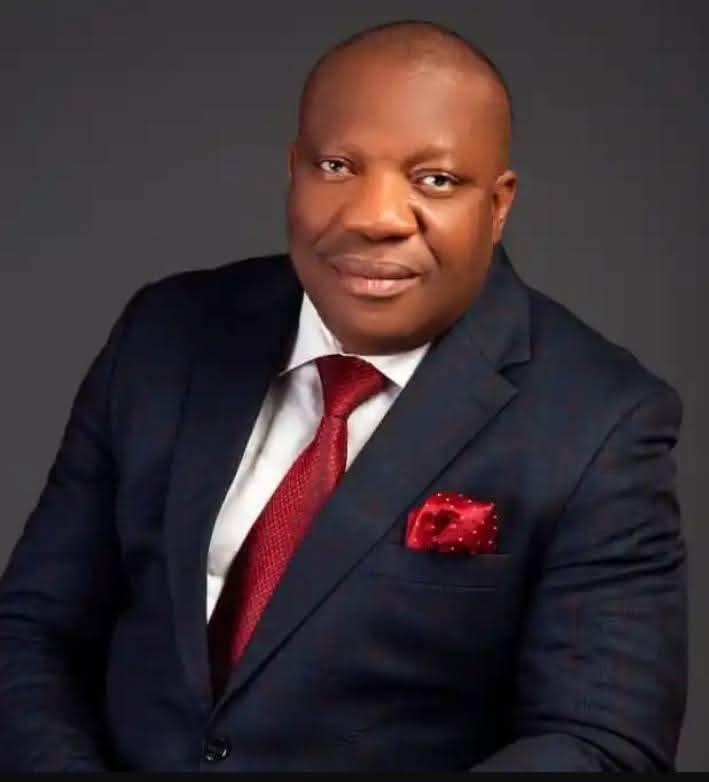
As Distinguished Senator Ekong Sampson, PhD, representing Akwa Ibom South Senatorial District, marks another birthday on Monday, September 21, attention naturally turns to the record of a legislator whose interventions have placed considerable emphasis on human capital development, particularly education.
For Senator Sampson, education appears to be more than a policy item. It is a tool for expanding opportunity, developing skills and preparing young people for the demands of a changing world.
His own academic and professional journey provides context to this emphasis. A professional journalist, author, poet and public affairs analyst, Senator Sampson holds a distinction in Mass Communication, an LLB and a Doctorate in Law. His educational trajectory has taken him through several disciplines and helped shape his public philosophy that knowledge remains one of the strongest foundations for sustainable development.
During the 2023 election campaign, education featured prominently in his manifesto. Since assuming office, his representation has included scholarships, grants, institutional support, educational infrastructure and legislative advocacy aimed at strengthening access to learning.
Among the interventions attributed to his office are a ₦100 million education grant benefiting 500 students and teachers; ₦200 million in project support to Akwa Ibom State University; ₦10 million for law students from the senatorial district studying at Nigerian Law Schools; and ₦5 million in support for students from Okobo through the Okobo Development Union.
According to records provided by his team, educational support has reached hundreds of students across the senatorial district, with attention given to indigent students studying science, law, medicine, nursing, technology, communication and accounting. The programmes have been presented as covering the 12 local government areas of Akwa Ibom South.
Beyond financial assistance, Senator Sampson’s educational interventions have included infrastructure. Computer-Based Test centres have been constructed at St. Vincent Secondary School, Oti-Oron, Okobo; Excellence College, Ikot Unya, Mkpat Enin and St. Francis Secondary School, Ikot Ataku, Okon Eket.
Other projects reportedly include school blocks, sports facilities, administrative buildings, hostels, perimeter fencing and technical upgrades at institutions including the Federal University of Technology, Ikot Abasi, Akwa Ibom State University, Ikot Akpaden, Government School, Ikot Ekpenyong, Girls High School, Ikot Ibiok, Eket and Community Secondary School, Udung Uko.
His legislative work has also focused on expanding the educational architecture of Akwa Ibom South. As Vice Chairman of the Senate Committee on Education (Basic and Secondary), he has advocated increased funding for agencies and institutions including UBEC and TETFund, particularly in relation to underserved communities.
His legislative portfolio includes sponsorship of the bill establishing the Federal University of Technology, Ikot Abasi, which, according to the record supplied, has reached third reading; the Federal University of Medical Sciences, Eket, at second reading; and advocacy for the full take-off of the University of Maritime Studies, Oron. The bill establishing the Federal Medical Centre, Akwa Ibom South, has also been passed into law, according to the same record.
But the Senator’s representation extends beyond education. His office has reported facilitating employment opportunities for more than 55 constituents in federal MDAs and corporate institutions, while business grants reportedly amounting to ₦500 million have been provided to beneficiaries. Young entrepreneurs have also received support in the form of vehicles, minibuses, tricycles and motorcycles to strengthen their businesses.
Healthcare has constituted another component of the representation. Newly constructed doctors’ call rooms have been commissioned at Immanuel Hospital, Eket, and General Hospital, Ikot Abasi, while additional projects have been planned for General Hospital, Iquita, Oron, and Cottage Hospital, Ibeno.
Taken together, these interventions point to a representation philosophy centred on human capacity, institutional development and practical support for constituents.
What makes Senator Ekong Sampson’s story particularly interesting is the apparent connection between his personal journey and the areas he has chosen to prioritise. His emphasis on education suggests a belief that representation should not merely respond to immediate needs but should also create pathways through which young people can acquire the knowledge, skills and opportunities required to compete.
At a time when political representation is often measured primarily by physical infrastructure, the emphasis on scholarships, educational grants, schools, training and legislative institutions offers another dimension to the debate about effective representation.
As he marks his birthday, therefore, Senator Ekong Sampson can be celebrated not only for occupying a seat in the Nigerian Senate, but for the human-capacity dimension of the work his office says it is pursuing.
The quiet human-capacity leader is another year older.
And perhaps the most enduring measure of such leadership will ultimately be found not in the number of projects commissioned, but in the lives of the students, entrepreneurs, professionals and communities whose opportunities have been expanded through public service.
Happy Birthday, Distinguished Senator Ekong Sampson, PhD.
May the years ahead bring greater wisdom, strength and opportunities to continue serving the people of Akwa Ibom South and Nigeria.
— Solomon OKPO
Political Analyst, Development Journalist and Publisher,
The Evangelist / Sports Recorder
Uyo, Akwa Ibom State