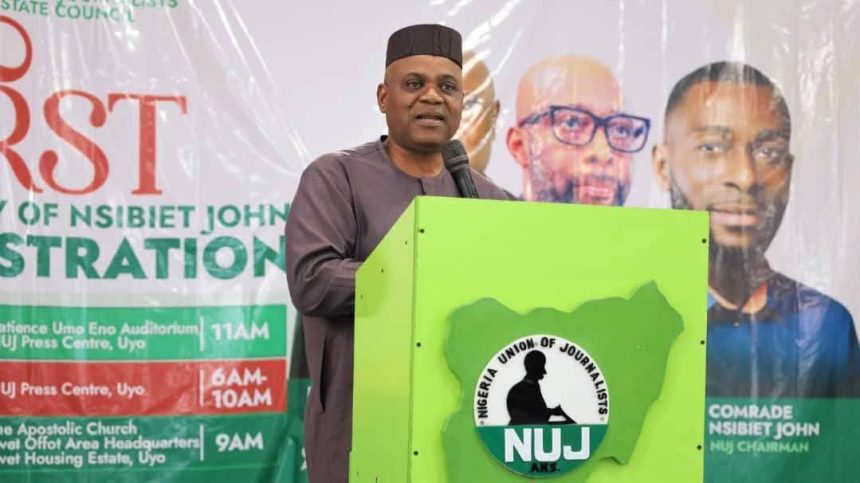
The Nigeria Union of Journalists (NUJ) Leadership Summit in Uyo has once again brought to the fore an issue that lies at the heart of every democratic society: the delicate balance between editorial independence and constructive engagement with the government.
The keynote address by the Akwa Ibom State Commissioner for Information, Rt. Hon. Aniekan Umanah, rightly acknowledged that both government and the media are indispensable partners in nation-building. However, partnership must never become dependency, and cooperation must never compromise the media’s constitutional responsibility to hold power accountable.
A free and independent press remains the strongest safeguard against abuse of power, corruption and poor governance. While governments deserve fair and objective reporting, journalists owe their ultimate loyalty not to political office holders but to the truth and to the public interest. Editorial decisions must be guided by facts, professional ethics and the conscience of the newsroom—not by political patronage, financial inducements or fear of reprisals.
The Evangelist welcomes the Commissioner’s emphasis on ethical leadership, professional responsibility and the responsible application of Artificial Intelligence in journalism.
As AI continues to reshape news gathering and content production, it should serve only as a tool to enhance journalistic efficiency, not replace editorial judgment, human integrity or the rigorous verification of facts. Credibility remains journalism’s greatest currency.
Equally commendable is the proposal to establish a Leadership and Media Excellence Academy and an independent Media Ombudsman. Continuous training is indispensable in an era marked by misinformation, digital disruption and evolving communication technologies.
Likewise, an effective ombudsman can strengthen public confidence in the media, provided its operations remain independent and insulated from political influence or external interference.
The welfare of journalists also deserves urgent attention. Poor remuneration, inadequate insurance, unsafe working conditions and limited career development expose media professionals to undue influence and ethical compromise.
A journalist who is economically vulnerable is often more susceptible to pressures that threaten editorial independence. Investing in journalists’ welfare is therefore an investment in democracy itself.
The leadership of the NUJ, under Comrade Nsibiet John, deserves commendation for organising a summit focused on strengthening leadership capacity and professionalism. Such initiatives are necessary if the union is to remain relevant in confronting contemporary challenges, defending press freedom and protecting the rights and dignity of journalists.
As The Evangelist has consistently maintained, cordial government-media relations should be built on mutual respect, not unquestioning loyalty.
Governments must tolerate criticism as an essential ingredient of democratic governance, while journalists must exercise their freedoms responsibly, fairly and professionally. A fearless but responsible press strengthens government by exposing weaknesses that require correction and by amplifying policies that genuinely serve the people.
Ultimately, the future of journalism in Akwa Ibom State and Nigeria depends on courageous leadership, unwavering ethical standards and an uncompromising commitment to truth. Editorial independence is not a privilege granted by government; it is a constitutional obligation that journalists must defend at all times. Democracy flourishes only when the press remains free, credible and accountable to the people above every other interest.
SPONSORED