

GLOBAL PHYSICS COLLABORATION TO BOOST STEM EDUCATION
— OTОBONG
By Solomon OKPO | The Evangelist Education News Desk
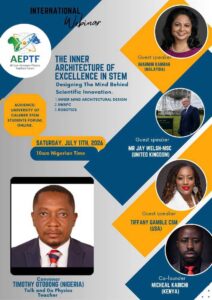
A Nigerian Physics educator and Founder/President of the African-European Physics Teachers Forum (AEPTF), Timothy Otobong, has called for stronger international collaboration among educators as a pathway to improving Science, Technology, Engineering and Mathematics (STEM) education, particularly in underserved communities.
Otobong made the call after participating in a conference with the Physics Teacher Forum organised by the Institute of Physics (IOP), United Kingdom, on September 17, 2026.
The conference, which brought together I4 Top Education Consultants and school partners, focused on strengthening Science education in Wales while providing opportunities for participants to exchange ideas and examine contemporary approaches to Physics teaching and experimental learning.
Otobong, who has been connecting Physics teachers across different countries through LinkedIn, said his participation also enabled him to contribute to discussions on improving Science education in Nigeria, with particular attention to strengthening STEM laboratory education in Ghana.
He said the conference exposed participants to technical areas including injection oscillation data, detection diagnostics, as well as KICK and BBQ data analysis, describing the experience as valuable in deepening his understanding of oscillation frequency and the interpretation of experimental data in Physics.
According to him, the real value of international educational collaboration lies in translating knowledge and experiences gained abroad into practical benefits for learners, especially those in communities where educational resources remain limited.
FOCUS ON RURAL LEARNERS
Otobong said he was particularly interested in using his international educational networks and experiences to support STEM education in public schools in Akwa Ibom State.
He identified rural communities as a major area of concern, noting that many learners in such areas have limited access to quality STEM resources.