By Solomon OKPO |The Evangelist Religion Desk
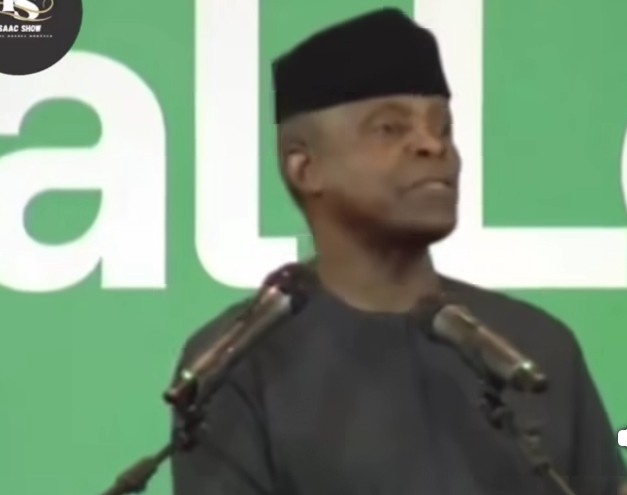
One of the most challenging messages from former Vice President, Prof. Yemi Osinbajo, is his warning about what happens when the Gospel is reduced to prosperity, miracles, breakthrough and material acquisition while the demands of righteousness, hard work, integrity and responsible living are pushed aside.
Osinbajo’s message is uncomfortable, but it deserves serious reflection.
His argument is not that God does not bless His people. Neither is he saying that prosperity is contrary to Christianity. Rather, he is challenging a version of Christianity that promises wealth without work, success without sacrifice, miracles without responsibility and blessings without character.
That kind of message may fill auditoriums, but it cannot transform a nation.
The Gospel of Jesus Christ was never designed merely to make people comfortable. It was designed to make people new.
When the Gospel enters a person’s heart, it should affect his character, his business, his family, his attitude toward public resources, his relationship with his neighbour and his sense of responsibility to society.
A Christian who speaks in tongues on Sunday but cheats customers on Monday has missed the essence of the Gospel.
A businessman who gives huge offerings in church but refuses to pay his workers their rightful wages has not understood biblical prosperity.
A politician who publicly professes Christ but steals public resources has contradicted the Gospel he claims to represent.
And a preacher who teaches people to seek miracles while neglecting diligence, productivity, honesty and responsibility risks producing a generation that wants harvest without planting.
This is where Osinbajo’s message becomes particularly relevant to Nigeria.
A nation cannot be transformed by miracles alone.
Nigeria needs prayer, certainly. Nigeria needs divine intervention. But Nigeria also needs men and women who will work honestly, create value, respect the law, reject corruption, keep their promises and take responsibility for the development of their communities.
The Bible itself does not glorify laziness.
Scripture says, “The soul of the sluggard desireth, and hath nothing: but the soul of the diligent shall be made fat.”
— Proverbs 13:4.
The Apostle Paul was even more direct:
“If any would not work, neither should he eat.”
— 2 Thessalonians 3:10.
Therefore, Christianity cannot be reduced to the pursuit of material blessings.
Jesus did not come merely to make people rich.
He came to save, transform and reconcile humanity to God.
He taught truth.
He demanded righteousness.
He confronted hypocrisy.
He condemned greed.
He taught compassion.
He demanded faithfulness.
He commanded His followers to become the salt of the earth and the light of the world.
That is the Gospel that transforms society.
Osinbajo has also made the important point that there is ultimately only one Gospel, the Gospel of Jesus Christ, rather than separate versions created around prosperity or other specialised promises.
This should provoke the Church to examine itself.
What are we preaching?
Are we raising disciples or merely attracting religious consumers?
Are we teaching people how to become Christlike, or only how to claim blessings?
Are we producing honest workers, responsible citizens and compassionate leaders?
Are our churches changing the communities around them?
The early Christians turned their world upside down because their faith was not confined to the four walls of a church building.
Their lives became the message.
Their character became their testimony.
Their love became their evidence.
Their honesty became their witness.
Their commitment to Christ affected society.
That is why the Church must recover the transforming power of the Gospel.
Nigeria does not merely need more churches.
Nigeria needs more transformed Christians.
We need Christians in government who will refuse corruption.
Christians in business who will refuse fraud.
Christians in professions who will reject dishonesty.
Christians in the workplace who will be diligent.
Christians in leadership who will put public interest above personal enrichment.
And Christians in every sphere of life who understand that Christianity is not merely what we profess with our lips; it is what our lives demonstrate.
The real test of the Gospel is not how loudly we shout “Amen.”
It is what kind of people we become after saying Amen.
If our churches are growing but corruption is also growing, something demands examination.
If our religious activities are increasing but honesty is declining, something is wrong.
If people are receiving miracles but society is not receiving transformed citizens, then the Church must return to the Scriptures and ask difficult questions.
The Gospel must not be adulterated to make it attractive.
The Gospel must be preached in its fullness.
Grace without truth produces compromise.
Prosperity without responsibility produces greed.
Faith without works produces emptiness.
Prayer without diligence produces excuses.
And religion without righteousness cannot transform a nation.
The challenge before the Church is therefore clear:
Preach Christ. Preach righteousness. Preach holiness. Preach love. Preach truth. Preach diligence. Preach responsibility. Preach the whole counsel of God.
For when the Gospel truly changes the heart, the changed heart will eventually change the home, the workplace, the community and ultimately the nation.
Food for thought: Nigeria will not be transformed merely because more people attend church. Nigeria will be transformed when the people who attend church allow Christ to transform the way they live.
May the Church recover the Gospel that does not merely promise to change our circumstances, but first changes us.
The strongest point to emphasise, in my view, is this: Osinbajo was not attacking Christianity or divine prosperity; he was challenging a distorted Gospel that separates God’s blessings from work, character and responsibility.
His 2025 remarks specifically connected miracle-money preaching with the danger of undermining national development.