By Solomon OKPO
The growing concern over the absence of a dedicated Ministry of Blue Economy in Akwa Ibom State is not misplaced. It exposes a major institutional gap in a state naturally positioned to become one of Nigeria’s strongest maritime economic hubs.
With over 6,208 maritime-related companies reportedly operating along the state’s coastal corridor, the argument is no longer about whether Akwa Ibom has blue economy potential. The real question is why the state is yet to establish a specialised structure to coordinate, regulate and maximise such enormous economic activity.
From offshore servicing and marine transportation to fisheries, dredging, oil and gas logistics, shipping support and coastal commerce, the maritime ecosystem in Akwa Ibom is already functioning as a major economic sector. Yet, it continues to operate without a centralised state framework specifically designed to manage its complexities, opportunities and environmental risks.
This absence becomes even more glaring considering the policy direction at the federal level. President Bola Ahmed Tinubu took a strategic step by creating the Federal Ministry of Marine and Blue Economy and appointing Adegboyega Oyetola to drive the initiative. The objective is clear: unlock the vast economic potential embedded in Nigeria’s marine resources and coastal assets.
Akwa Ibom, with its long Atlantic coastline and increasing maritime investments, should ordinarily be among the first states aligning aggressively with that national vision. Instead, the state risks losing investment opportunities, revenue streams and regional competitiveness due to fragmented coordination and weak sector-specific governance.
The blue economy is not merely about water. It is about jobs, industrial growth, export expansion, tourism, coastal infrastructure, environmental sustainability and global investment attraction. Nations and subnational governments that understand this are rapidly building institutions around maritime development because they recognise that future economic power will increasingly depend on coastal and marine resources.
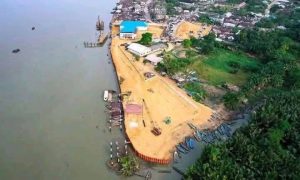
Without a dedicated ministry, critical areas such as maritime safety, environmental monitoring, data management, investment regulation and inter-agency coordination remain vulnerable to inefficiency. The implications affect not only government revenue but also coastal communities whose livelihoods and environmental security depend heavily on properly regulated marine activities.
There is also the issue of planning. No serious sector grows sustainably without institutional ownership.
A Ministry of Blue Economy would provide the strategic direction needed to map maritime assets, attract investors, enforce compliance standards and create long-term development policies tailored to Akwa Ibom’s coastal realities.
Governor Umo Eno has consistently projected an economic expansion agenda for the state. Establishing a Ministry of Blue Economy would fit naturally into that vision. It would demonstrate forward-thinking leadership and place Akwa Ibom in a stronger position within Nigeria’s evolving maritime economy.
The reality is simple: nature has already given Akwa Ibom a competitive advantage. What remains is the political and administrative will to convert that advantage into structured economic prosperity.
Delaying the creation of a Ministry of Blue Economy may eventually prove more costly than establishing one now.