

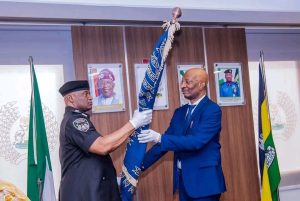
Tunji Disu steps into office at a time when the Nigeria Police Force is not merely under scrutiny but under siege by public distrust, institutional fatigue, and operational decay. As Nigeria’s 23rd indigenous police chief, his emergence is not just a routine change of baton. It is a stress test for leadership in one of the country’s most critical yet battered institutions.
Let’s be blunt.
The Nigeria Police Force does not suffer from a shortage of press releases. It suffers from a shortage of boots, belts, barracks, and basic dignity for its rank and file. Any new Inspector-General who fails to confront these realities head-on will merely preside over continuity disguised as reform.
The question before Disu is simple but brutal: will he govern the Force from conference halls, or from the barracks?
Across area commands, officers still struggle with inadequate uniforms, worn-out boots, and substandard operational kits. In some divisions, patrol vehicles are skeletal remains of what they once were. Mechanical workshops that once kept operational vehicles alive have either collapsed or become relics of a more functional era. The result is predictable: poor mobility, delayed response, and compromised policing.
No institution commands public respect when its personnel appear abandoned by the system they serve.
Accommodation remains another sore point. Many officers live in conditions unfit for those entrusted with public safety. If leadership does not prioritize decent housing, morale will remain fragile. And when morale collapses, discipline and professionalism follow.
Then there is the manpower deficit. Policing a nation of over 200 million people with an overstretched workforce is not strategy, it is strain management. Recruitment without training reform is cosmetic. Deployment without logistics is self-deception. What the Force requires is structural recalibration, not ceremonial appointments.
Disu’s tenure must not be defined by crime statistics alone. It must be measured by institutional repair.
Will area commands regain functional mechanical workshops?
Will officers receive timely kits without resorting to personal funds?
Will training evolve beyond outdated doctrines?
Will welfare move from promise to policy?
Leadership is not about occupying the office of Inspector-General; it is about altering the culture of that office.
If Disu dares to confront procurement leakages, internal patronage networks, and systemic inefficiencies, he may yet etch his name into history. If not, he risks becoming another chapter in a familiar narrative of hope deferred.
Nigeria does not need another ceremonial police chief.
It needs a reformer willing to make uncomfortable decisions one who understands that security begins with equipping those sworn to provide it.
The storms are real. The uniformed men and women on the streets feel them daily. The public feels them nightly.
The question now is whether Disu will weather the storm or finally rebuild the ship.
The Evangelist News