

Deep in the hills of Cross River State lies a small farming community that has baffled linguists and intrigued cultural enthusiasts worldwide. In Ubang, language itself wears gender — men and women speak entirely different vocabularies for everyday words, yet understand each other perfectly.
In Ubang households, a father may call a tree “okyin,” while the mother refers to the same object as “onggim.” For water, the man says “bala” while the woman says “lili.” Shoes become “okpok” for men and “abuo” for women. Even a simple cup is “nkoh” for men and “ogbala” for women.
Children first grow up with their mothers’ vocabulary, but boys switch to the “male language” around age five or six, guided by fathers and uncles. By adolescence, the transformation is complete, and the household lives with two parallel languages, one masculine, one feminine.
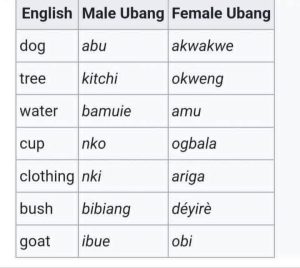
Community elders believe Ubang’s gift of dual tongues came from God, who once left a giant footprint on the village mountain, a sacred symbol still visible today. According to legend, God gave men and women different vocabularies to prevent quarrels, or perhaps to confuse enemies during war.
Scholars, however, suggest the system could have emerged from contact with multiple ethnic groups, coded speech in secret societies, or the differing roles of men and women in daily life.
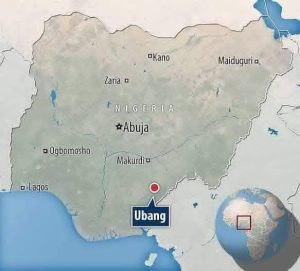
Whatever the origin, linguists have documented over 400 vocabulary items with gender distinctions, making Ubang one of the most unique language communities in the world.
Despite its uniqueness, modern life is eroding Ubang’s linguistic heritage. With English and Pidgin dominating schools and cities, many young people no longer undergo the traditional language shift. Elders fear the tradition may vanish with the next generation.
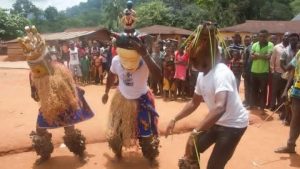
In response, community leaders have launched evening classes and language documentation projects to preserve both vocabularies before they fade away.
Among the more than 7,000 languages worldwide, Ubang may be the only community where vocabulary itself is split by gender. For Nigeria, it is not just a linguistic curiosity but a cultural wonder, a living reminder of the country’s diverse and irreplaceable heritage.
Visitors to Ubang, not far from the Obudu Mountain Resort, are encouraged to see the sacred footprint, hear the dual vocabularies, and witness a community where difference is not division, but unity.