By Solomon OKPO
There is a saying my late mother repeated whenever rumours reached our home: “The eye that has seen needs no witness.” Her message was simple: before judging a matter, go and see for yourself.
That childhood lesson returned to me last week when I travelled to Akwa Ibom State, my home state, with three questions on my mind. I wanted to witness the grand finale of the state’s 39th anniversary celebrations, particularly the Variety Night at the new ARISE Palm Resort in Uyo. I also wanted to answer, for myself, the persistent question being raised on social media: What exactly is Governor Umo Eno doing with Akwa Ibom’s resources?
There was a third question. Governor Eno had given Nsik Engineering Ltd., the contractor handling the Midim-Etim Ekpo Road project, a July 2026 deadline to demonstrate meaningful progress or risk losing the contract. I wanted to know whether the warning had translated into action. That part of my journey will come later.
I arrived at the new terminal of Victor Attah International Airport, Uyo, at about 6:15 p.m. on Tuesday, September 22, aboard Ibom Air.
The terminal immediately commanded my attention.
From the air bridge to the arrival hall, the architecture, lighting, landscaping, passenger facilities and general ambience created an impression far removed from the stereotypical experience of many Nigerian airports. Even the toilets, often an afterthought in public infrastructure, were remarkably well presented.
Having travelled outside Nigeria, I have seen several impressive airport facilities. Yet, standing inside the new Uyo terminal, I could not help but admire what had been created at home.
But the airport was only the beginning.
Inside the Airport Clinic
The following morning, I contacted the Akwa Ibom State Commissioner for Health, Dr. Ekem Emmanuel, and told him that I wanted to see, firsthand, the health projects being developed under his supervision.
He assigned two career officials of the ministry to accompany me, one a biosystems engineer and the other a medical scientist.
By 9 a.m., we were on the road.
Our first stop was the Airport Clinic within Victor Attah International Airport. The facility is designed to provide comprehensive medical services, including emergency care, maternity and paediatric services.
I toured the operating theatre, emergency theatre, male and female wards, maternity and paediatric sections, as well as the laboratory.
Medical equipment was still being installed in some sections, with several items remaining in their original crates. Workers across different disciplines were busy trying to meet project deadlines.
The officials explained that the facility would serve the aviation community while also providing general medical services to communities around the airport.
As I walked through the facility, one thought kept returning to me: this was clearly more than a conventional airport first-aid clinic.
A ROAD NETWORK Taking Shape
From the airport, we headed towards the emerging medical corridor.
We travelled along the Ring Road-Three corridor before joining the Ring Road-Three Extension, a major road project awarded under Governor Umo Eno and approaching completion.
The scale of the project became increasingly apparent as we moved along the route.
Hensek Engineering workers were busy at various sections of the construction site, while solar-powered streetlights were being installed along the median.
The dual carriageway stretches towards the Uyo-Ikot Ekpene highway.
For a journalist interested in development, such projects raise an important question: how should infrastructure be judged, by political speeches and social-media arguments, or by what is physically delivered on the ground?
In this case, the answer was visible through the windscreen.
Much of the road passes through previously undeveloped areas. There were construction workers, equipment, surveyors and heavy machinery, but relatively few buildings along substantial portions of the route.
THE ELDERLY HAVE A HOME
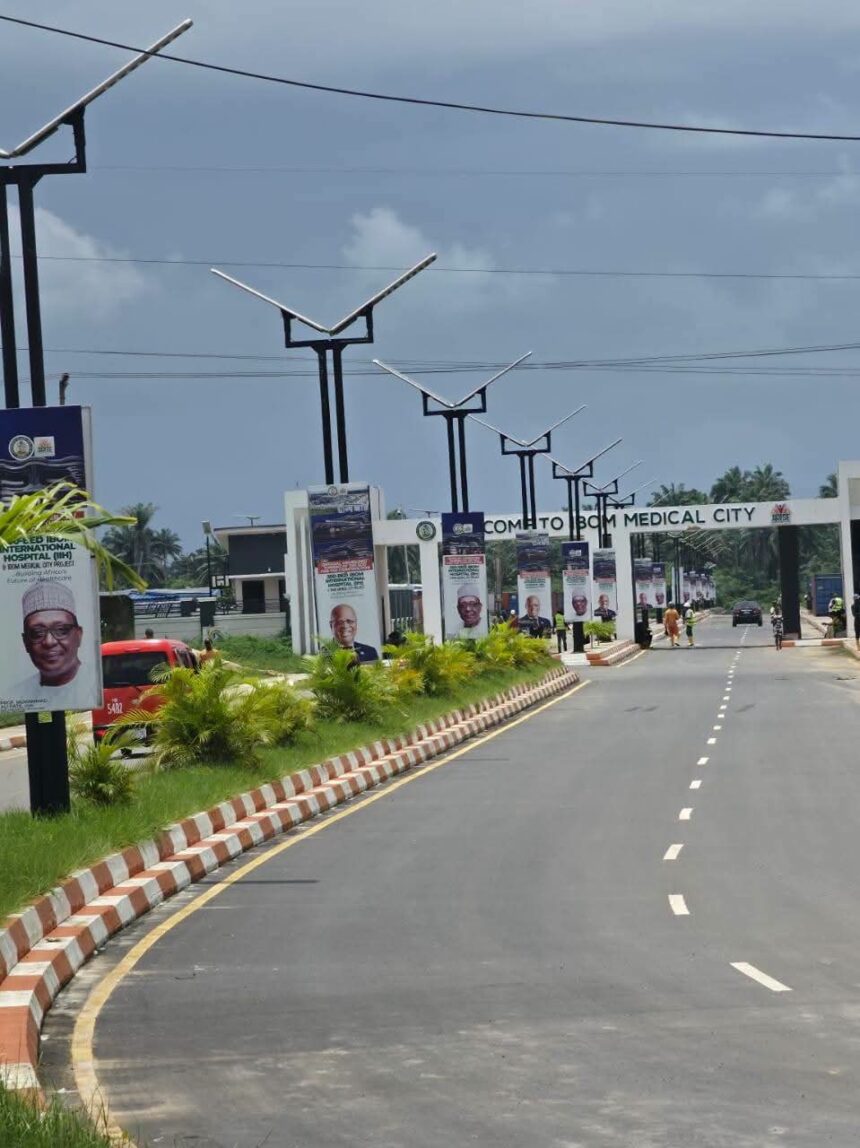
Our journey took us towards the Ibom Medical City.
Near the imposing entrance, one of my guides pointed out an elegant building.
“That is the Oluremi Tinubu Home for the Elderly,” she explained.
I asked whether the facility was actually occupied.
“Yes,” came the response.
According to my guides, elderly men and women who had lacked adequate accommodation and care had been moved into the facility, where they receive support and access to specialist geriatric services.
It was another reminder that infrastructure is not always about roads and buildings. Sometimes, it is about what happens to vulnerable people inside those buildings.
THE IBOM INTERNATIONAL HOSPITAL
Our next destination was the Ibom International Hospital, situated within the emerging Ibom Medical City.
As we entered the complex, the scale of the project became immediately obvious.
The facility was not simply a collection of buildings. Engineers, technicians and other workers were actively engaged in completing different components of what is expected to become a major healthcare centre.
Dr. Isokoriari, the supervising engineer, took me through sections of the project and explained the thinking behind the facility’s design, construction and medical infrastructure.
Then came the moment that would stay with me.
I found myself standing in a basement before an enormous concrete structure. The wall was approximately 1.8 metres thick.
I looked at it again.
Then I looked at the supervising engineer.
For a moment, I struggled to understand why such an enormous wall of concrete was necessary in a hospital.
The explanation changed everything.
This was not ordinary construction. The engineering requirements were tied to the specialised medical functions the facility is being designed to accommodate.
Standing there, I realised that some of the most consequential infrastructure projects are the least visible from the roadside. Their value lies not merely in what the public sees, but in the engineering, technology and systems hidden beneath and behind the walls.
And that brought me back to my mother’s old saying.
The eye that has seen needs no witness.
I came to Akwa Ibom with questions.
I did not return with every answer.
But I certainly saw enough to understand that there is far more happening on the ground than can be captured by social-media arguments, political slogans or official speeches.
The Evangelist News