By Solomon OKPO | The Evangelist Opinion Desk
The latest National Examinations Council (NECO) results have presented Akwa Ibom State with an uncomfortable reality that should not be buried under the familiar Nigerian culture of shifting blame.
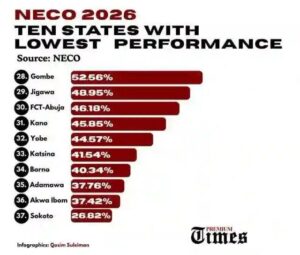
According to reported state-by-state analysis of the 2026 NECO results, only 37.42 per cent of candidates in Akwa Ibom obtained at least five credits, including English Language and Mathematics. The state was placed 36th among the 36 states and the Federal Capital Territory. This represents a sharp decline from the 67.08 per cent recorded by the state in 2025.
That is not merely an examination statistic. It is a warning signal about the health of the education system.
Already, the blame game has begun. Some may blame the students for not studying hard enough. Others may point accusing fingers at parents, teachers, principals or school administrators. There may be some truth in each of these arguments because education is a shared responsibility. But there is one question that must not be avoided: Who is responsible for the system?
In every organised system, leadership cannot take all the applause when things go well and suddenly disappear when things go wrong.
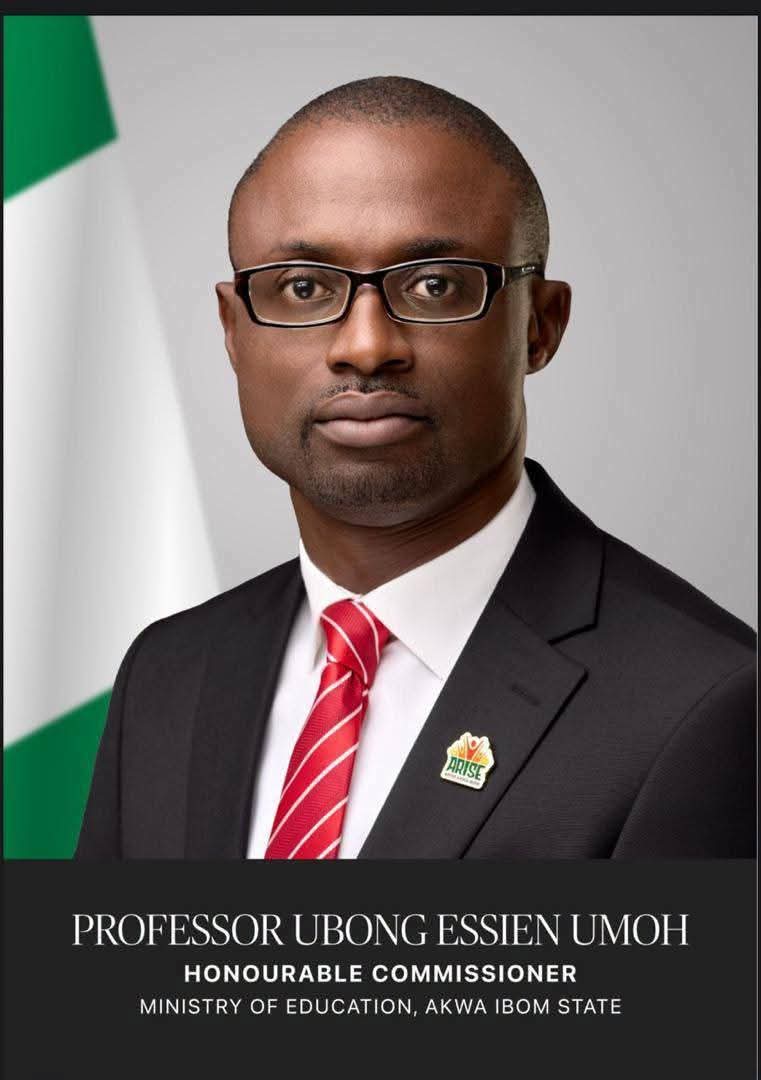
The Commissioner for Education may not personally teach every child, mark every script or supervise every classroom, but the office carries responsibility for policy direction, supervision, standards, monitoring and overall performance of the education sector.
That does not mean the Commissioner should be made the sole culprit for every student’s failure. That would be equally simplistic. Students have responsibilities. Parents have responsibilities. Teachers and school administrators have responsibilities. But leadership has the responsibility to ensure that all these components of the system are functioning effectively.
The questions, therefore, are unavoidable. Are our classrooms sufficiently conducive to learning? Are teachers adequately trained, motivated and supported? Are school heads providing effective academic leadership?.
Are government interventions reaching the schools that need them most? How regularly does the Ministry monitor actual teaching and learning? Are schools with persistent poor results being identified and given special attention? Where problems are discovered, what corrective measures are taken?
These questions are more important than looking for convenient scapegoats.
The national picture itself shows that the 2026 result requires serious scrutiny. NECO reported that 58.67 per cent of candidates nationwide obtained at least five credits, including English and Mathematics, down from 60.26 per cent in 2025. But Akwa Ibom’s reported 37.42 per cent is considerably below the national figure. That gap demands an honest institutional examination.
The answer cannot simply be: “The students did not read.”
If thousands of young people pass through a system and the system repeatedly produces disappointing outcomes, the system itself must be interrogated. Good leadership does not wait until examination results are released before discovering that something has gone wrong.
The Ministry of Education should therefore move beyond public relations and undertake a serious post-NECO diagnostic exercise. The data should be broken down by local government area, school, subject and other relevant indicators. Schools with exceptional performance should be studied to understand what they are doing differently, while persistently poor-performing schools should receive targeted intervention.
Teacher development must also become continuous rather than occasional. Contemporary education requires teachers who are equipped not merely to complete the syllabus but to prepare students for critical thinking, problem-solving and increasingly competitive examinations.
School supervision must equally be strengthened. A monitoring visit should not be a ceremonial appearance in a school compound. It should establish whether teachers are teaching, students are learning, facilities are functional and government interventions are producing measurable results.
There is also a lesson in the experience of other Nigerian states. Anambra’s education reforms under the administration of former Governor Peter Obi are often cited as an example of how sustained political attention and institutional reforms can alter educational outcomes.
Whatever differences may exist in the circumstances, the broader lesson is clear: educational decline is not inevitable when leadership is prepared to confront it deliberately.
Akwa Ibom does not need another round of accusations and counter-accusations. It needs facts, accountability and action.
If the problems confronting the education sector require resources beyond the Ministry’s present capacity, the Commissioner has an obligation to place those needs squarely before the Governor and make a compelling case for intervention. Leadership also means asking for what is necessary to solve a problem.
Most importantly, the children must remain at the centre of this conversation.
Behind every percentage is a child. Behind every failed subject is a dream that may be delayed.
Behind every poor school is a community whose future may be affected. And behind every examination result is a verdict, however imperfect on how well the education system is preparing the next generation.
The NECO result should therefore not become a political football. It should become a wake-up call.
The Commissioner should take responsibility for leading the review. Teachers should take responsibility for improving instruction. Parents should take responsibility for supporting their children. Students must take responsibility for their studies. Government must take responsibility for providing the environment and resources required for quality education.
That is what shared responsibility means.
But at the end of the day, the buck must stop somewhere.
Leadership means accepting responsibility when the system succeeds and confronting responsibility when it fails.
Akwa Ibom must now ask itself a difficult but necessary question:
Are we preparing our children for the future or merely preparing excuses for their failures?