BY SOLOMON OKPO
The unfolding political drama in Eket Federal Constituency ahead of the 2027 elections is not just another episode of local rivalry, it is a defining test of how far identity politics should shape democratic choice. At the centre of this storm is Hon. Okpolopm Etteh, a sitting federal lawmaker now navigating what can only be described as a tightening political noose.
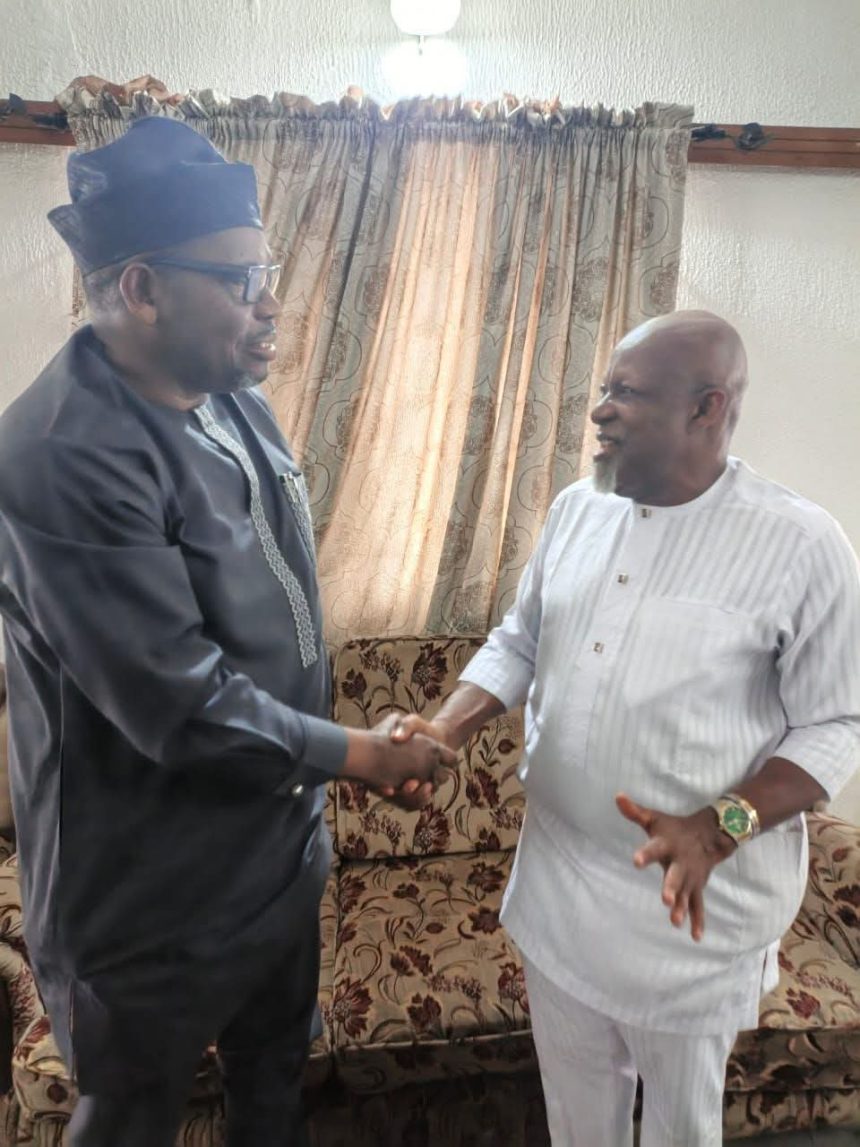
His recent visit to Dr. Samuel Udonsak, President General of the Ekid People’s Union (EPU), was clearly more than a courtesy call. It was a strategic move, an attempt to reset a narrative that is fast slipping beyond his control. Yet, if anything, the meeting reinforced a hard truth: the political ground beneath Etteh has shifted, perhaps irreversibly.
The EPU’s so-called “doctrine of necessity” is the elephant in the room. Framed as a corrective response to perceived marginalisation, it effectively shuts the door on candidates of Ibeno origin, regardless of individual merit or performance. That is a bold, even audacious political line to draw in a democratic setting that ideally thrives on inclusivity and competition.
Supporters of the doctrine argue from a position of historical grievance. They insist that political power within the constituency has not been equitably distributed and that decisive action is needed to rebalance the scales. In their view, this is not exclusion, it is self-preservation.
But there is an uncomfortable flip side. When a community declares it would support “even a goat” so long as it meets a narrow ethnic criterion, it risks reducing democracy to a mechanical exercise in identity affirmation. Competence, experience, and legislative effectiveness, qualities Etteh pointedly highlighted, become secondary considerations.
Etteh’s defence rests on his incumbency advantage.
He argues, not without reason, that continuity in the National Assembly brings leverage: committee influence, policy networks, and access to federal opportunities. In a system where ranking often translates into tangible benefits, replacing an experienced lawmaker carries its own risks.
However, political capital is not built on performance alone, it is sustained by perception and trust. The controversies he sought to distance himself from, whether fairly or not, have fed into a broader narrative that his opponents are now weaponising. In politics, perception frequently outruns facts.
The EPU, for its part, is playing a long game. By issuing a pre-emptive directive to political parties and threatening electoral boycott, it is testing the strength of its grassroots influence. This is a high-stakes brinkmanship.
If parties comply, the EPU consolidates its authority. If they resist and still win, the doctrine collapses under its own weight.
What is clear is that 2027 in Eket will not be decided by routine campaign rhetoric. It will be shaped by a deeper contest between two competing visions: one that prioritises rotational or corrective justice, and another that leans on continuity and institutional advantage.
Etteh’s challenge, therefore, is not merely electoral, it is existential. He must convince a sceptical bloc that his candidacy transcends the identity debate, while simultaneously retaining relevance within party structures that may already be recalibrating their strategies.
The danger for the constituency is that this standoff, if mishandled, could fracture political cohesion and weaken its collective bargaining power at the federal level. When internal divisions dominate, external influence diminishes.
Eket stands at a crossroads. The choice before its people is not simply about who occupies a seat in Abuja, it is about what principles will define their politics going forward. Will it be grievance-driven exclusion, or a broader, performance-based inclusiveness?.
That decision will echo far beyond 2027.