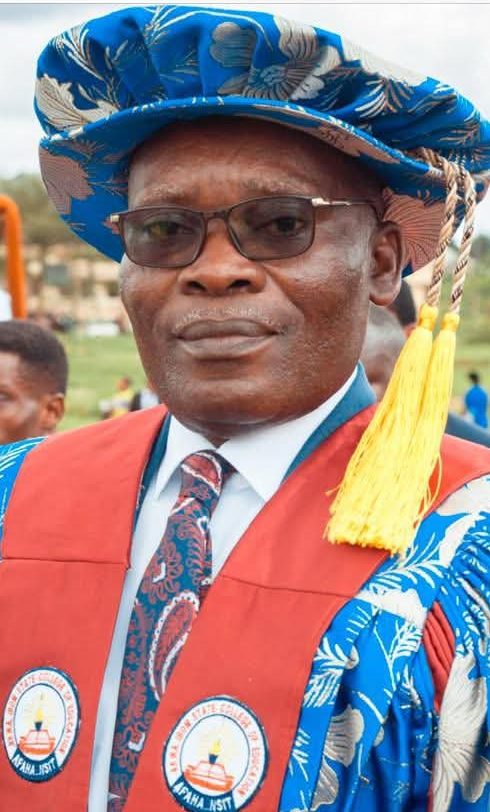
After six years of service marked by institutional stability, digital transformation and steady growth, Professor Daniel Udo has concluded his tenure as Provost of the College of Education, Afaha Nsit, leaving behind a legacy many stakeholders describe as impactful and reform-driven.
Professor Udo assumed leadership in October 2019 as Acting Provost and later substantive head at a period widely regarded as challenging for tertiary institutions nationwide. His administration navigated the disruptions of the COVID-19 lockdown, which affected academic schedules, infrastructure utilisation and revenue streams. Despite these setbacks, the college recorded no major academic disruptions, maintaining calendar stability and institutional continuity.
A major highlight of his tenure was the comprehensive digitalisation of the institution, particularly the revival and upgrade of the Computer-Based Test (CBT) centre. Once blacklisted by the Joint Admissions and Matriculation Board (JAMB), the centre regained accreditation under his leadership and was transformed into a modern examination facility with a 250-candidate capacity, CCTV surveillance and upgraded infrastructure.
The centre now hosts JAMB examinations, teacher certification tests, recruitment assessments and other national and state examinations, enhancing the college’s academic relevance and revenue base.
Administrative and financial reforms were also central to the six-year stewardship.
The introduction of ICT-driven payment systems streamlined fee processing, strengthened financial documentation and improved transparency. The administration further addressed inherited tax liabilities while embarking on infrastructural expansion, including the completion of abandoned projects and the initiation of new ones to improve the learning environment.
Academically, the college sustained its core Nigeria Certificate in Education (NCE) and Degree programmes, while expanding access through sandwich, part-time and amnesty programmes designed to cater to diverse categories of learners. Staff development through promotions, seminars and welfare initiatives received attention, alongside improved student support services and sustained engagement with the host community.
Significantly, industrial disharmony that previously disrupted the academic calendar was effectively curtailed during Professor Udo’s tenure. His strict adherence to due process and institutional regulations reportedly ended recurring labour crises, although this approach drew resistance from some union elements accustomed to a less structured system, leading at times to open confrontations.
Described by many as an academic, principled administrator and leader of excellence, Professor Udo is also noted as a strong supporter of Governor Umo Eno’s ARISE Agenda, aligning the institution’s reforms with the state government’s broader development vision.
As the College of Education transitions into a newly upgraded university, several stakeholders and interest groups are said to be hopeful for Professor Udo’s return to head the institution, citing his record of adaptability, innovation and human-centred leadership.
While opinions may vary, his six years in office are widely regarded as a period that stabilised the institution, entrenched digital reforms and positioned it for sustained academic and infrastructural growth.
Uwem Ekoh