BY SOLOMON OKPO
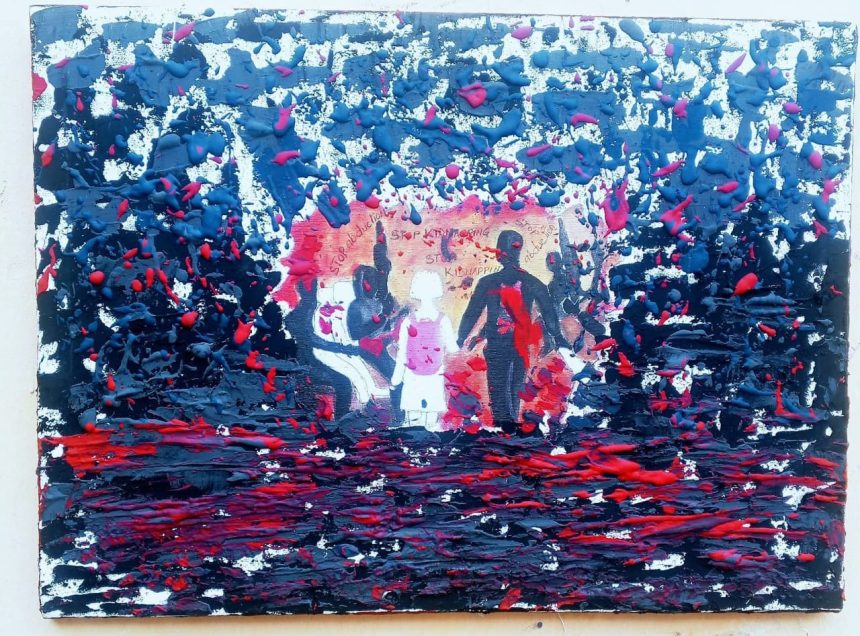
Kidnapping has evolved from a disturbing criminal enterprise into one of the gravest threats to families and communities. Beyond the statistics and news headlines lie shattered childhoods, grieving parents, and societies forced to live in fear. It is against this backdrop that artist Archie Abia Godwin presents “Stolen Innocence: A Cry Against Kidnapping,” a work that transcends aesthetics to become a compelling call for justice and collective responsibility.
At the heart of the textured canvas is the white silhouette of a child, a striking symbol of innocence, purity, and vulnerability. The child’s isolation amidst looming dark figures captures the terrifying reality faced by countless victims of abduction. The shadows represent more than kidnappers; they embody the fear, violence, greed, and lawlessness that continue to threaten the safety of children and communities.
The artist’s use of a glowing yellow-orange background is particularly significant. It functions simultaneously as an alarm and a source of hope. The bold inscriptions, “Stop Kidnapping” and “Stop Abduction,” transform the painting into a visual protest, reminding viewers that silence is no longer an option. Every citizen, institution, and government has a role to play in ending this scourge.
Equally striking are the dominant black tones and dramatic red splashes across the canvas. The darkness reflects despair, uncertainty, and terror, while the red evokes the bloodshed, emotional trauma, and lifelong scars left on victims and their families. These elements force viewers to confront the devastating human cost of kidnapping rather than merely observe it from a distance.
Perhaps the painting’s greatest strength lies in its symbolism. The sharp contrast between the brilliant white figure and the surrounding darkness represents the eternal struggle between innocence and evil, hope and despair, protection and exploitation. It reminds us that children should never become commodities in criminal enterprises or victims of society’s failures.
Art has always possessed the power to challenge injustice, inspire dialogue, and awaken conscience. “Stolen Innocence: A Cry Against Kidnapping” does precisely that. It is not merely a painting to be admired in a gallery; it is a social statement demanding accountability, stronger security measures, effective law enforcement, and community vigilance.
Archie Abia Godwin deserves commendation for using his artistic talent to address one of the defining humanitarian challenges of our time. His work reminds us that the fight against kidnapping is not solely the responsibility of security agencies.
Parents, schools, religious institutions, community leaders, policymakers, and citizens must work together to safeguard children and restore public confidence.
Ultimately, the painting asks a simple but profound question: How many more innocent lives must be stolen before society acts decisively? Until every child can live without fear of abduction, the message of “Stolen Innocence” will remain painfully relevant. It stands as both a memorial to victims and a powerful reminder that protecting the innocent is a responsibility shared by us all.