Infrastructure remains one of the clearest measures of governance. Roads, bridges and transport networks are not merely physical structures; they are economic lifelines that determine whether communities thrive or remain trapped in isolation. In this regard, the decision by Umo Eno to embark on the construction of 40 strategic bridges across Akwa Ibom State deserves serious attention, not as a political spectacle, but as a deliberate attempt to solve structural problems that have hindered development for decades.
For many riverine and hard-to-reach communities in Akwa Ibom, geography has long been a burden. Entire settlements have struggled with poor access to schools, healthcare centres, markets and government services because rivers, swamps and seasonal flooding cut them off from the rest of the state. In several areas, residents depended on unsafe wooden crossings, canoes or seasonal ferries to move people and goods. Such realities created economic stagnation and deepened rural neglect.
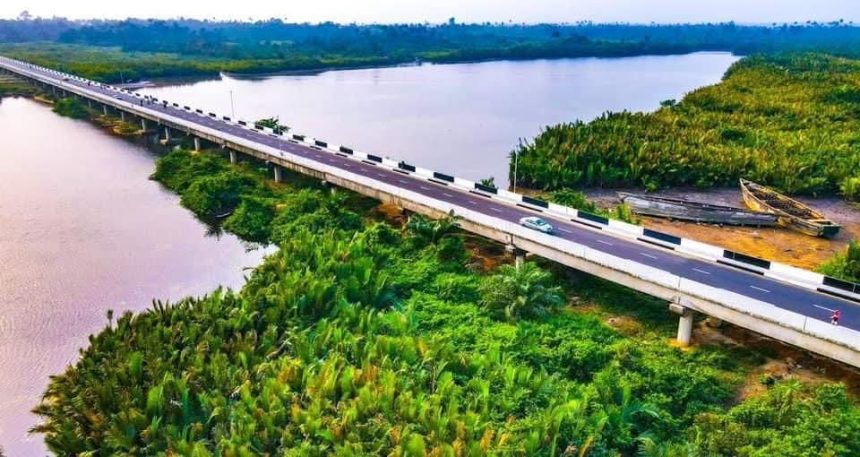
The ongoing bridge projects represent a direct response to that challenge. By connecting communities previously separated by difficult terrain, the administration is not only constructing concrete structures but also building economic and social inclusion. Connectivity is development, and any government that ignores this principle inevitably leaves parts of its population behind.
What makes this initiative particularly significant is its integrated planning approach. The bridges are not isolated monuments standing in empty locations; they are being linked with road construction and rehabilitation projects to create continuous transportation corridors.
This reflects a broader understanding that infrastructure works best when it functions as a coordinated network rather than scattered interventions.
The economic implications are substantial. Farmers can now transport produce to urban markets more efficiently, reducing spoilage and post-harvest losses. Traders gain easier access to commercial centres, while transport costs decline for both businesses and ordinary citizens. These changes may appear gradual, but over time they can fundamentally reshape local economies.
Equally important is the social impact. Improved accessibility means children in remote communities can attend school more consistently, pregnant women and emergency patients can reach healthcare facilities faster, and rural populations no longer feel abandoned by government presence. During flooding seasons, when many communities historically became inaccessible, these bridges could prove lifesaving for emergency responders and security agencies.
The engineering considerations behind the projects also indicate a long-term perspective. Flood-resistant designs, elevated structures, erosion control systems and durable construction materials are necessary in a coastal and riverine environment like Akwa Ibom. Too often in Nigeria, infrastructure fails prematurely because environmental realities are ignored. A project of this scale must therefore be judged not only by how many bridges are commissioned, but by how durable and sustainable they remain over the years.
Still, infrastructure development should not escape scrutiny simply because it is ambitious. The government must ensure transparency in contract execution, quality control and maintenance planning. Nigerians have seen too many public projects deteriorate due to poor supervision, inflated costs or abandonment after political transitions. Akwa Ibom cannot afford such waste. These bridges must become enduring public assets rather than temporary political symbols.
There is also the question of sustainability beyond construction. Infrastructure without maintenance culture eventually collapses into decay. The state government should begin planning for periodic inspections, repairs and environmental monitoring to preserve the bridges for future generations. Community ownership and local participation in protecting these assets should equally be encouraged.
Nevertheless, the broader direction of the initiative reflects a development philosophy that prioritizes inclusion over concentration. Historically, development in many states has remained urban-centred, leaving rural populations disconnected from opportunities. By extending infrastructure into difficult terrains and underserved regions, the administration is acknowledging that development cannot be meaningful if it excludes the most vulnerable communities.
Ultimately, Governor Umo Eno’s 40-bridge initiative is more than an engineering programme. It is a statement about the kind of Akwa Ibom that can emerge when infrastructure is used as a tool for integration, mobility and shared prosperity.
If properly executed and sustained, these bridges may not only connect roads; they may connect forgotten communities to opportunity, dignity and a stronger future.