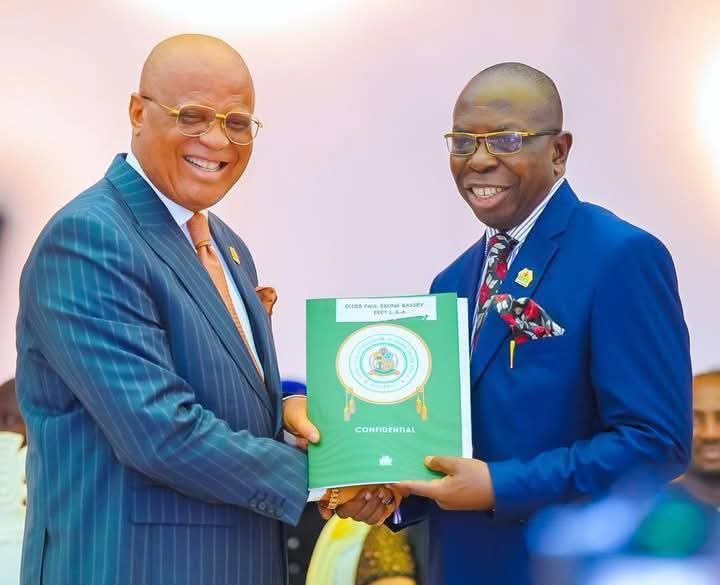
By Solomon OKPO
When Governor Umo Eno submitted his list of commissioner nominees to the Akwa Ibom State House of Assembly in early 2025, the inclusion of Paul Bassey was widely viewed as a strategic choice rather than a routine political appointment.
For many observers of sports development in the state, it signalled a deliberate shift toward professionalism and experience in sports administration.
One year after assuming office on February 24, 2025, the record suggests that the decision has begun to pay off.
Paul Bassey entered office at a critical moment.
The Ministry of Sports had just been separated from the former Ministry of Youth Development and Sports, making him the pioneer commissioner of the standalone ministry. Such structural transitions often come with uncertainty, institutional adjustments, and policy recalibration. Yet the first twelve months have demonstrated a level of administrative clarity and purposeful leadership that has placed the sector on a more stable footing.
Perhaps the most visible early test of his leadership came with the hosting of the maiden Niger Delta Games. Hosting a regional sporting competition of that scale demands meticulous planning, infrastructure readiness, and coordinated logistics.
Under Bassey’s supervision, Akwa Ibom not only hosted the event successfully but also used the opportunity to review performance gaps and prepare strategically for future competitions. That follow-up evaluation exercise reflected a management style focused on improvement rather than celebration alone.
Equally significant was the revival of the Akwa Ibom Sports Festival after seven years of inactivity.
The festival had historically served as a breeding ground for grassroots talent. Its return in 2025 restored an important talent discovery pipeline and reaffirmed the state’s commitment to nurturing athletes from the local level. For a state that prides itself on sporting excellence, the festival’s reintroduction was long overdue.
Beyond events and competitions, Bassey’s tenure has also addressed one of the most persistent weaknesses in Nigerian sports administration: athlete motivation. By rewarding medalists from the National Youth Games, the ministry sent a clear signal that performance would no longer go unnoticed. Recognition and reward remain essential tools for sustaining competitive morale among young athletes.
Infrastructure development has also featured prominently in the ministry’s activities. The launch of the Ibom Gym at the Godswill Akpabio International Stadium represents a strategic investment in athlete conditioning and training. Modern sports increasingly depend on scientific preparation, and facilities like this help close the gap between local athletes and international standards.
The simultaneous procurement of sports equipment for more than forty sports associations further reinforced the administration’s commitment to comprehensive sports development. From athletics to indoor games such as chess and scrabble, the initiative broadened the support base beyond football, creating opportunities for diverse sporting talents across the state.
Performance indicators have also shown measurable improvement.
At the second edition of the Niger Delta Games, Team Akwa Ibom secured 55 medals 16 gold, 17 silver, and 22 bronze to finish fourth overall behind established powerhouses such as Edo, Delta, and Bayelsa. While not yet a dominant position, the result reflects upward momentum and validates the state’s renewed focus on talent development.
Another noteworthy dimension of Bassey’s leadership has been administrative capacity building.
The organisation of a three-day in-house training programme for ministry staff demonstrated an understanding that sports development requires efficient institutional support. By investing in staff competence, the ministry strengthened the administrative backbone required to sustain policy implementation.
Equally innovative was the facilitation of a partnership between Akwa United F.C. and Ibom Air. The arrangement has improved travel logistics for the club, enhanced fan engagement during home matches, and eased operational costs. For a professional team competing across long distances in the Nigerian football league system, such partnerships can make a critical difference.
Public engagement has also improved with the launch of the “Kickoff Akwa Ibom” radio programme on Inspiration 105.9 FM. By opening a channel for sports updates, analysis, and grassroots promotion, the ministry has taken a step toward making sports administration more transparent and participatory.
Taken together, these initiatives reflect a leadership style grounded in experience, strategic thinking, and consistent engagement. Bassey’s background as a veteran sports journalist and football administrator has evidently shaped his approach, one that values both operational detail and long-term vision.
However, the real test lies ahead. Sustaining the momentum will require deeper investment in grassroots academies, continuous infrastructure expansion, and stronger private sector partnerships.
The proposed development of sports facilities within the ARISE Resort in Uyo and the anticipated activation of the Ibom Sports Academy could further redefine the state’s sports ecosystem if implemented effectively.
One year is often too short to measure the full impact of public administration, yet the early indicators in Akwa Ibom’s sports sector suggest that the ministry is moving in the right direction. If the current trajectory is maintained, the state may soon reclaim its position as one of Nigeria’s most formidable sporting powerhouses.
In the final analysis, the first year of Elder Paul Bassey as sports commissioner demonstrates what can happen when experience meets opportunity and when leadership is matched with a clear developmental agenda.
The Evangelist Newsl