By Akanimo Sampson|Solomon OKPO
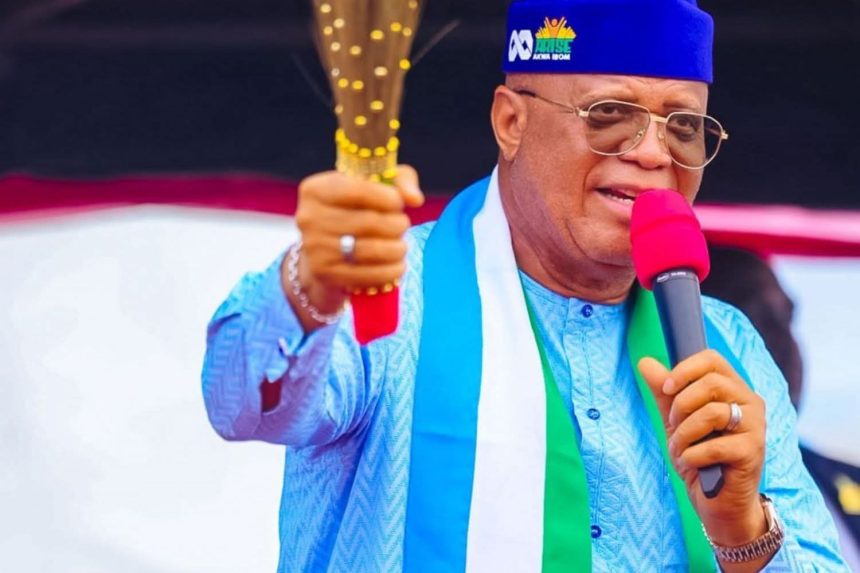
Governor Umo Eno of Akwa Ibom State leveraged the Moneyline Investment Forum in Abuja to spotlight the strides made under his ARISE Agenda, even as a politically influential faction of the Peoples Democratic Party (PDP) in the state continues to openly back his reported 2027 re-election ambition despite his defection to the All Progressives Congress (APC).
Though absent from the Thursday event, Eno was represented by the Commissioner for Information, Aniekan Umanah, and the Managing Director of the Akwa Ibom Investment Corporation, Imoh Abasi Jacob. His delegation reiterated the governor’s position that Akwa Ibom is converting federal fiscal and financial reforms into practical opportunities that enhance wealth creation and strengthen long-term economic stability.
Six months after crossing to the APC, Eno retains significant support from a PDP faction loyal to Federal Capital Territory Minister Nyesom Wike. The group, which operates from the party secretariat at Atan Offot in Uyo, has kept the governor’s portraits and posters displayed as though he remains the party’s flagbearer for 2027. The situation mirrors the turmoil triggered by Eno’s defection, which deepened long-running internal divisions within the state PDP.
Aniekan Akpan, the immediate past state PDP chairman, has refused to relinquish control even after the National Working Committee (NWC) announced the dissolution of his executive and named a new caretaker structure led by Umoren Iquat. Akpan has challenged the decision, accusing Abuja-based party officials of issuing directives without a formally convened meeting. He cites a counter-statement from National Secretary Samuel Anyanwu rejecting earlier reports that his executive was disbanded—adding yet another layer of confusion to the party’s internal crisis.
Although party leaders have offered no explanation for the continued presence of Eno’s campaign materials at the Uyo secretariat, the facility remains fully operational, with a regular security presence that includes police officers and a patrol vehicle stationed at the entrance.
At the Abuja forum, themed “Nigeria’s New Financial Landscape: Reforms, Risks, and the Road to Wealth Creation,” Governor Eno applauded the Tinubu administration for a raft of reforms—including the Investment and Securities Act 2025, the Insurance Industry Reform Act 2025, new tax legislation, and electricity market deregulation. He described the policies as transformative but noted that their success depends on how effectively subnational governments convert them into tangible economic gains.
Eno used the platform to showcase major projects under the ARISE Agenda a five-pillar development blueprint encompassing agricultural revolution, rural development, infrastructure expansion, security management, and educational advancement. According to him, ongoing initiatives such as the expansion of Ibom Air, new road networks, deployment of CNG-powered city buses and plans for a light rail system are reshaping mobility and connectivity across the state.
He also highlighted maritime and industrial projects, including the Ibom Deep Seaport, Ibom Industrial City, and six economic zones such as the Liberty Oil and Gas Free Trade Zone, describing them as crucial to unlocking the state’s emerging Blue Economy.
Tourism and agriculture, he emphasized, remain key growth drivers. Major facilities under construction or renovation include the ARISE Palm Resort, a 5,000-seat International Convention Centre, ARISE Shopping City, the Ibom Hotel and Golf Resort, and Raffia City Hotel operated by Four Points Sheraton. Agricultural ventures, from model farms to large-scale oil palm and coconut plantations and cottage garri processing centres are strengthening rural incomes and enhancing food security.
Eno also celebrated the achievements of the Ibom Leadership and Entrepreneurial Development Agency, which he said has trained more than 10,000 youths and women through grants, skills development and mentorship programmes.
Calling for stronger collaboration between federal and state governments, Eno maintained that Akwa Ibom’s economic progress demonstrates how disciplined planning can convert national reforms into meaningful prosperity. He invited investors to “Come. Live. Invest in Akwa Ibom,” reaffirming the state’s readiness to support both domestic and international businesses.