
By Solomon OKPO
EKET, Former Minister of Lands, Housing and Urban Development, Rt. Hon. Chief Nduese Essien, has criticized the proliferation of political empowerment schemes in Nigeria, describing them as ineffective and a distraction from real governance.
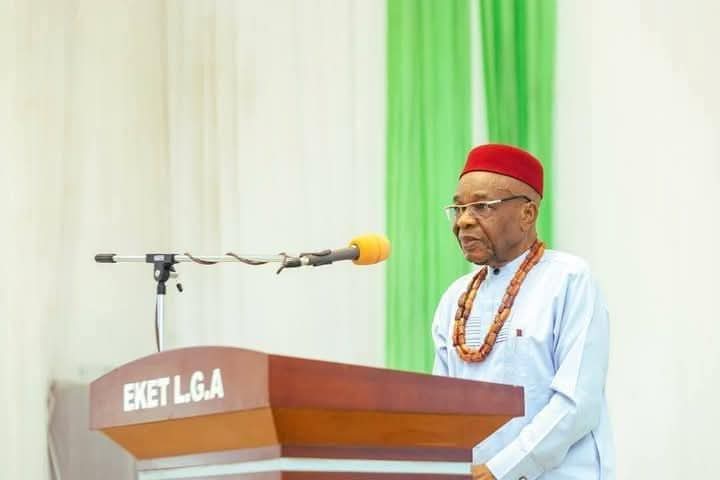
Speaking at a public event in Eket, Chief Essien, who also served as the leader of the South-south Parliamentary Caucus in the National Assembly, dismissed these programmes as “a ruse” used by politicians to conceal systemic failure and waste public funds.
“The so-called empowerment programmes are largely a cover-up for years of government failure and yet another avenue to squander the people’s money,” he declared.
He argued that what Nigerians need are lasting solutions, not short-term handouts. According to him, during the colonial and early post-independence eras, such schemes were nonexistent because government fulfilled its core duties.
“Empowerment wasn’t part of our political vocabulary before 1999. The government, in many ways, did its job, creating environments where people could live with dignity and work for their survival,” he said.
Chief Essien highlighted global examples of sustainable models from countries like Brazil, Mexico, Ethiopia, Bangladesh, and Rwanda, where economic support is tied to measurable outcomes such as education, healthcare, and skills development.
He criticized Nigeria’s Ministries of Humanitarian Affairs for becoming “conduits for reckless embezzlement” rather than instruments of social impact.
“All the ministers of humanitarian affairs in Nigeria have been accused of misappropriating billions meant for distressed citizens. It’s time we called it what it is, institutionalized looting,” he said.
He further called for anti-corruption agencies to take decisive action and urged the government to rethink its response to poverty and vulnerability.
“Stop sharing rice and cash. People don’t want handouts. They want opportunities, land, loans, training, stable power, and the infrastructure to succeed,” he emphasized.
Chief Essien also advised lawmakers to focus on their constitutional duties rather than duplicating executive functions under the guise of empowerment, which he warned only deepens corruption and inefficiency.
He concluded with a powerful call for reform: “Let us restore governance to its rightful place. Let us build systems that promote dignity, not dependency.”