By Solomon OKPO | The Evangelist Feature Desk
Akwa Ibom State Governor, Pastor Umo Bassey Eno, has unveiled an ambitious development blueprint, ARISE Agenda 2.0, outlining his administration’s priorities for 2027–2031, with the proposed Uyo City Centre Project emerging as the signature infrastructure initiative of the next phase of his leadership.
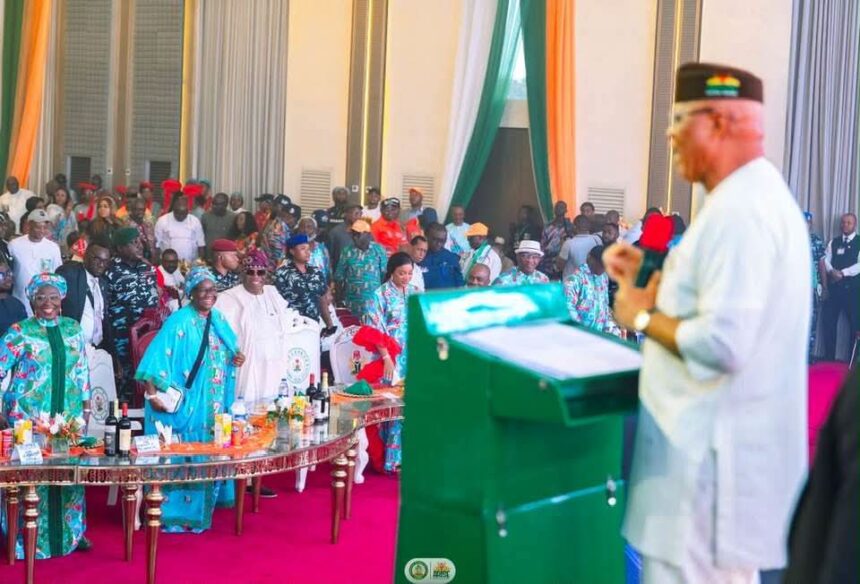
The manifesto, unveiled at the Banquet Hall of ARISE Palm Resort, Uyo, during the inauguration of the Akwa Ibom State APC Campaign Council, signals the administration’s intention to move beyond the consolidation of existing projects to a more expansive development agenda anchored on infrastructure, agricultural productivity, rural transformation, security, education, healthcare and economic diversification.
The unveiling marks a significant moment in the state’s political and development landscape ahead of the 2027 general elections, as Governor Eno seeks a renewed mandate to sustain the implementation of his administration’s five-pillar ARISE Agenda.
At the heart of the new blueprint is the proposed Uyo City Centre Project, which the Governor has identified as a defining symbol of the next phase of urban transformation in Akwa Ibom.
Situated around the strategic convergence of Wellington Bassey Way, Oron Road, Aka Road and Ikot Ekpene Road, the proposed project is designed to reposition Uyo as a modern commercial, transportation and tourism destination.
The development will feature a two-level roundabout system, an elevated flyover, a CNG bus terminal, dedicated taxi and minibus bays, as well as commercial and recreational facilities. Its components will include Ibom Plaza, a proposed City Tower and Ibom Mall, creating an integrated urban environment expected to attract private investment, stimulate commercial activities and generate employment.
The proposed City Tower, inspired by the Akwa Ibom State Coat of Arms, is also expected to incorporate architectural elements reflecting the state’s oil and gas heritage, cultural identity and coastal resources.
Beyond its aesthetic appeal, the project represents an attempt to address the growing demands of an expanding state capital while creating a new economic and recreational centre.
FROM ARISE 1.0 TO ARISE 2.0: CONSOLIDATING THE GAINS
In presenting the new manifesto, Governor Eno placed considerable emphasis on the administration’s reported achievements under ARISE 1.0, arguing that the next phase would build on the foundations already established across the state’s 31 local government areas.
Under the Agricultural Revolution and Food Security pillar, the administration highlighted the distribution of 620,000 oil-palm seedlings, establishment of the Ibom Equipment Leasing Facility and provision of agricultural grants to farmers.
Five of the six major agricultural objectives under the first phase were reported as substantially achieved.
For ARISE 2.0, the government intends to expand mechanised farming, strengthen farmer cooperatives, increase access to agricultural financing and technology, develop agro-processing facilities and expand oil-palm and other tree-crop plantations.
A major component of this strategy is the completion and operationalisation of the pilot Ibom Model Farm, with plans to replicate the facility in the other two senatorial districts.
The initiative, if effectively implemented, could strengthen food security, encourage commercial agriculture, reduce dependence on food imports from other states and create opportunities across the agricultural value chain.
RURAL DEVELOPMENT: 1,000 COMPASSIONATE HOMES, 310KM ROADS
In the area of rural development and community prosperity, the administration highlighted the delivery of approximately 500 fully furnished two-bedroom homes under the ARISE Compassionate Homes Programme for vulnerable citizens.
Other interventions include rural road construction, bridges, solar-powered water facilities and empowerment programmes.
The second phase seeks to double the number of compassionate homes to 1,000 across the state’s wards and construct 310 kilometres of rural roads, with an allocation target of 10 kilometres in each of the 31 local government areas.
The manifesto also promises improved access to potable water, electricity, healthcare, education and other essential amenities, alongside stronger support for ward-level cooperatives and rural enterprises.
These commitments place rural communities at the centre of the administration’s proposed development strategy, although their success will ultimately depend on timely execution, equitable distribution and effective monitoring.

INFRASTRUCTURE: ₦934.33BN INVESTMENT IN FOCUS
Infrastructure remains one of the most prominent components of the administration’s performance assessment.
According to the manifesto, 1,515 kilometres of road projects have been constructed across the state, including inherited projects funded by the present administration, at a reported cost of ₦934.33 billion, excluding projects under the Rural Access and Agricultural Marketing Project (RAAMP).
The administration also reported the construction of 43 bridges and the installation of 6,386 out of 6,441 approved solar-powered streetlights, representing approximately 95 per cent completion.
The transition from diesel-powered to solar-powered streetlights was said to have reduced monthly diesel consumption by 78.7 per cent.
Other infrastructure achievements highlighted include the completion of the new terminal building at Victor Attah International Airport, introduction of the Compressed Natural Gas (CNG) Mass Transit Scheme and commencement of the Oron Maritime Infrastructure Development Project.
For the next phase, the Governor is proposing additional rural road construction, improved infrastructure maintenance, expanded digital connectivity and wider urban renewal programmes.
The challenge, however, will be to ensure that these investments translate into durable infrastructure, improved mobility and measurable economic benefits for residents and businesses.
SECURITY: TECHNOLOGY-DRIVEN PROTECTION
On security and good governance, ARISE 1.0 recorded the establishment of a standalone Ministry of Internal Security and Waterways, Security Command and Control Centre, Ibom Community Watch and Security Trust Fund.
The administration also highlighted the deployment of patrol vehicles, 14 gunboats for waterways security and the integration of 2,272 village youth presidents into the state’s security architecture.
ARISE 2.0 proposes a more technology-driven security framework, including the deployment of surveillance cameras, scanners and other security equipment across the 31 local government areas.
The proposed measures will be complemented by improved intelligence gathering, inter-agency cooperation and rapid-response capabilities.
Given the strategic importance of Akwa Ibom’s coastal communities, waterways and commercial corridors, the proposed expansion of security infrastructure could strengthen public confidence and create a more favourable environment for investment.
EDUCATION AND YOUTH EMPOWERMENT: INVESTING IN HUMAN CAPITAL
Education and youth development also occupy prominent positions in the new manifesto.
The administration reported the establishment of 35 Model Primary Schools, surpassing the original ARISE 1.0 target of 10, while sustaining free and compulsory education.
It also highlighted the payment of ₦778.9 million to cover examination-related expenses for 48,797 candidates and ₦1.69 billion in bursaries to 25,527 students.
In youth development, the monthly ₦50,000 support programme has reportedly benefited more than 29,618 young people since its commencement in October 2024.
The government also cited the establishment of 31 Youth Development Centres, training of more than 1,800 youths through Ibom-LED, with grants of ₦750,000 each upon completion, and 2,661 beneficiaries under the DASAC programme, each receiving ₦1 million in grants.
The administration further reported 8,854 public-sector jobs and other employment opportunities across education, healthcare, the civil service and technical and vocational sectors.
Under ARISE 2.0, the emphasis will shift towards technical and vocational education, digital skills, innovation, entrepreneurship and stronger connections between education and employment.
The broader objective is to prepare young people not merely for government employment but also for opportunities in the private sector and emerging economic industries.

HEALTHCARE: BUILDING A REGIONAL MEDICAL HUB
In healthcare, the administration reported the construction of 31 Primary Healthcare Centres, completion and commissioning of the General Hospital, Ukanafun, and ongoing construction of the General Hospital, Ibiono Ibom.
The manifesto also highlighted the establishment of three medical oxygen production plants with a combined capacity of 240 cylinders daily, employment of 2,854 healthcare workers and expansion of the Akwa Ibom State Health Insurance Scheme to 248,000 beneficiaries across more than 400 accredited healthcare facilities.
The proposed Ibom Medical Village and development of Ibom Medical City, anchored by a planned 350-bed Ibom International Hospital, form part of the administration’s ambition to reposition the state as a regional healthcare destination.
For ARISE 2.0, the focus will be on specialist healthcare services, improved medical financing, technology-driven service delivery and sustained investment in medical infrastructure.
If realised, this vision could reduce medical tourism outside the country, improve access to specialised treatment and attract healthcare professionals and investors to the state.
TOURISM AND ECONOMIC DIVERSIFICATION
Tourism is another sector expected to receive increased attention under the second phase.
The administration identified the development of ARISE Palm Resort, the 5,000-capacity Ibom International Convention Centre and the 220-room Ibom International Hotel as major investments in the state’s hospitality and tourism infrastructure.
The rehabilitation and repositioning of Ibom Hotels and Golf Resort, internationalisation of Victor Attah International Airport in 2025 and commencement of Ibom Air’s international expansion, including scheduled Uyo–Accra services in 2026, were also highlighted.
The next phase, according to the manifesto, will focus on transforming these facilities into commercially sustainable assets through destination branding, coordinated tourism marketing and greater private-sector participation.
This is particularly significant given Akwa Ibom’s natural attractions, cultural heritage, hospitality potential and strategic coastal location.
The emerging vision of Destination Akwa Ibom is to make the state more competitive as a tourism, conference, aviation and hospitality destination.
AKPABIO, ASSAM BACK ENO’S SECOND-TERM BID
The unveiling attracted strong political support, including the President of the Senate, Senator Godswill Obot Akpabio, who expressed confidence in Governor Eno’s leadership and the development direction of the state.
Akpabio urged the people of Akwa Ibom to support the Governor’s re-election bid, declaring that the future of the state and its children was secure under his leadership.
“Today, Pastor Umo Eno has assured us that not only is the future of Akwa Ibom State secure, but the future of our children is also guaranteed,” the Senate President said.
He further challenged the electorate with the question: “If Akwa Ibom does not vote for Umo Eno, then who?”
Also speaking, the Director-General of the Campaigns, Chief Assam Assam, SAN, called on the people to support the Governor for a second term, expressing confidence in the administration’s performance and its proposed development direction.
THE ROAD AHEAD: FROM PROMISES TO MEASURABLE RESULTS
Ultimately, ARISE 2.0 presents Governor Eno with an opportunity to consolidate the gains of his first administration while addressing the developmental expectations of Akwa Ibom people.
Its proposed projects and programmes are wide-ranging, touching virtually every critical sector of the state’s economy and social life.
However, the credibility of the new agenda will not rest solely on the scale of its promises or the attractiveness of its proposed infrastructure. Its real test will be implementation, transparency, responsible management of public resources, measurable outcomes and the ability to ensure that development reaches communities across the three senatorial districts.
The proposed Uyo City Centre, in particular, could become a landmark of urban transformation if backed by sound planning, adequate financing, effective traffic management and sustainable commercial partnerships.
From mechanised agriculture and rural roads to healthcare, aviation, tourism and technology-driven security, the Governor’s second-phase blueprint seeks to position Akwa Ibom for a more diversified and competitive future.
For Governor Eno, the message of ARISE 2.0 is clear: the first phase was about laying foundations; the next is expected to consolidate, expand and translate those foundations into broader prosperity.
Whether that ambition becomes a defining chapter in Akwa Ibom’s development history will ultimately be determined by the quality of execution and the benefits delivered to the people.