
By Solomon OKPO
In politics, endorsements are often loud but fleeting. What is unfolding across Akwa Ibom South (Eket) Senatorial District, however, is neither routine applause nor seasonal political theatre. It is a calculated, cross-generational, and cross-partisan convergence around one central proposition: continuity.
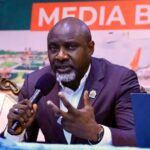
At the heart of this growing consensus is Ekong Sampson, Chairman of the Senate Committee on Solid Minerals Development and Senator representing Akwa Ibom South in Nigeria’s 10th National Assembly. As 2027 gradually enters political conversations, a critical mass of stakeholders traditional leaders, political heavyweights, youth blocs, professionals, women groups, and community actors, are making their position unmistakably clear: the district cannot afford to lose legislative momentum.
The Ranking Advantage
Nigeria’s parliamentary culture rewards experience. In the Senate, longevity is leverage. Ranking determines committee influence, negotiation power, and access to strategic decision-making spaces. It shapes how quickly projects move from proposal to execution.

That logic was reinforced during the December 30, 2025 stakeholders’ resolution at Villa Marina, Eket, where representatives from the twelve Local Government Areas took a firm stance against the culture of one-term representation. Their message was blunt: performance should earn continuity.
The meeting followed a strategic assurance by Umo Eno, who pledged return tickets to senators aligned with the All Progressives Congress (APC). Yet beyond party calculations, the deeper issue remains institutional strength. A ranking senator carries more weight in Abuja than a freshman legislator learning the ropes.
As Dr. Emmanuel Ekuwem pointedly observed during the inauguration of the “Believers of Senator Ekong Sampson” support group, continuity translates into bargaining capital. In a federal system where influence drives allocation, that capital matters.

Legislative Footprint That Commands Attention
Support for Sampson is anchored less in rhetoric and more in documented legislative productivity.
Among the bills credited to his sponsorship or co-sponsorship are:
The Federal University of Technology, Ikot Abasi Bill (awaiting third reading);
The Federal Medical Centres Amendment Bill (now law);
The Federal Medical Centre, Eket Bill (now law);
The South-South Development Commission Bill (passed into law);
Sustained advocacy for the take-off of the Federal University of Maritime Studies, Oron.
Beyond bill sponsorship, he has amplified debates on maritime development, coastal economy reform, environmental sustainability, industrial revitalisation, and the reactivation of ALSCON in Ikot Abasi a long-standing economic pressure point in the district.
In a legislature often criticised for symbolic motions, stakeholders argue that Sampson’s record reflects substance.
Education as Structural Investment
If legislative drafting defines presence in Abuja, educational intervention defines presence at home.

The ₦100 million Education Grant benefiting 500 students and 25 teachers stands out as one of the most far-reaching educational support initiatives in the district’s recent history. It is not mere philanthropy; it is a structural investment.
At the Federal University of Technology, Ikot Abasi, Vice-Chancellor Prof. Leo Daniel publicly acknowledged Sampson’s infrastructural backing and institutional advocacy. For a region seeking to reposition itself within Nigeria’s knowledge economy, such alignment between lawmaker and institution is strategically significant.
Education, in this context, is not charity. It is long-term economic architecture.
Constituency Impact: Beyond Ceremony
Across the twelve Local Government Areas of Akwa Ibom South, intervention patterns reveal deliberate sectoral spread:
Over ₦500 million in SME grants;
Targeted student support in Okobo through the Okobo Development Union;
Facilitation of employment for over 50 constituents in federal agencies;
Skills acquisition and mobility empowerment (vehicles, buses, tricycles, motorcycles);
Erosion control in Ekeya (Okobo);
Electrification projects with 500KVA transformers;
Road construction in Mkpat Enin;
Solar-powered boreholes and street lighting;
ICT/CBT centres in secondary schools;
Staff quarters, hostels, classroom blocks, and medical facility upgrades in Eket, Ikot Abasi, and Iquita.
The breadth suggests a representative attempting to balance human capital, infrastructure, and economic stimulation rather than focusing on politically visible but isolated projects.
Bipartisan Confidence
Endorsements have not been confined to party loyalists. Figures such as Rt. Hon. Chief Nduese Essien, Barr. Bassey Dan Abia, Arc. Otu Ita Toyo, Rt. Hon. Patrick Ifon, Rt. Hon. Peter Linus Umoh, Dr. Emmanuel Ekuwem, Rt. Hon. Owoedighe Ekpoatai, Prof. Peter Esuh, and Hon. Mrs. Abigail Edohoket have openly expressed confidence in his leadership trajectory.
Their support reflects a rare political moment: performance cutting across factional lines.
The Real Question
The debate in Akwa Ibom South is no longer about ambition; it is about strategy.
Can the district afford to reset its legislative ranking just as influence is consolidating? Can it risk substituting institutional familiarity for experimentation at a time when federal bargaining power determines developmental pace?.
By measurable standards, bill sponsorship, law passage, project facilitation, education investment, and stakeholder alignment, the argument for continuity rests on evidence, not emotion.
For many within Akwa Ibom South (Eket) Senatorial District, retaining Ekong Sampson beyond 2027 is not political sentimentality. It is strategic preservation of leverage.
In a system where influence compounds over time, interrupting momentum carries a cost. And increasingly, stakeholders appear unwilling to pay it.
The Evangelist News
SPONSORED